
Overview Table
| Attribute | Details |
|---|---|
| Product Name | PlayStation Portal |
| Type | Remote Play handheld device |
| Developer | Sony Interactive Entertainment |
| Primary Function | Streams gameplay from a PlayStation 5 console |
| Display | 8-inch LCD |
| Resolution | 1080p |
| Refresh Rate | 60Hz |
| Connectivity | Wi-Fi (Remote Play streaming) |
| Audio | Dual speakers + 3.5mm headphone jack |
| Controls | Integrated DualSense with haptic feedback and adaptive triggers |
| Battery Life | Varies based on usage pattern |
| Game Compatibility | PS5 and PS4 games installed on the user’s PS5 via Remote Play |
| Online Requirement | Always requires Wi-Fi; does not run games locally |
| Storage | Not required for gaming; system streams only |
| Target Audience | Gamers seeking PS5 play away from the TV within stable internet zones |
Introduction
The PlayStation Portal is one of the most debated and influential pieces of handheld gaming hardware of the decade, not because it follows traditional portable gaming design, but because it breaks away from it. It is not a console, not a cloud-gaming streaming stick, and not a smartphone accessory. It is a hybrid identity: a dedicated PlayStation Portal for streaming your PlayStation 5 experience wherever you are, without being tied to the main household television and without forcing you onto a mobile touchscreen. It is a device built around a single philosophy: when someone else is using the TV, the game should not stop.
To understand the purpose of the PlayStation Portal, one must first understand what it is not. It does not run games locally. It does not accept game downloads. It does not allow game purchases directly on the device. It does not attempt to replicate the PlayStation 5 in portable format. The PlayStation Portal serves a single mission: to take the full PS5 and PS4 library you already own and make it instantly playable around the home or anywhere with stable internet.
In an era where companies try to make a single device perform every function at once, Sony dared to build a device that performs one function with absolute dedication. And that strategic choice — to value clarity of purpose over versatility — is what makes the PlayStation Portal so fascinating.
The Philosophy Behind the PlayStation Portal
Sony analyzed behavioral patterns of PS5 users worldwide and found something profound. Many players were not limited by lack of time but by lack of TV access. Families share screens. Roommates rotate use. Partners negotiate usage. Gamers themselves may simply want to play in a different room while someone else watches a movie or uses streaming services.
Sony’s designers realized a truth that does not appear in sales charts but exists in nearly every gaming household: access to the PS5 is often limited by access to the TV. So Sony asked a simple question: what if the PS5 could follow the player instead of the player following the TV?
The PlayStation Portal is the answer to that question.
A Handheld Built Around Immersion Instead of Portability Specs
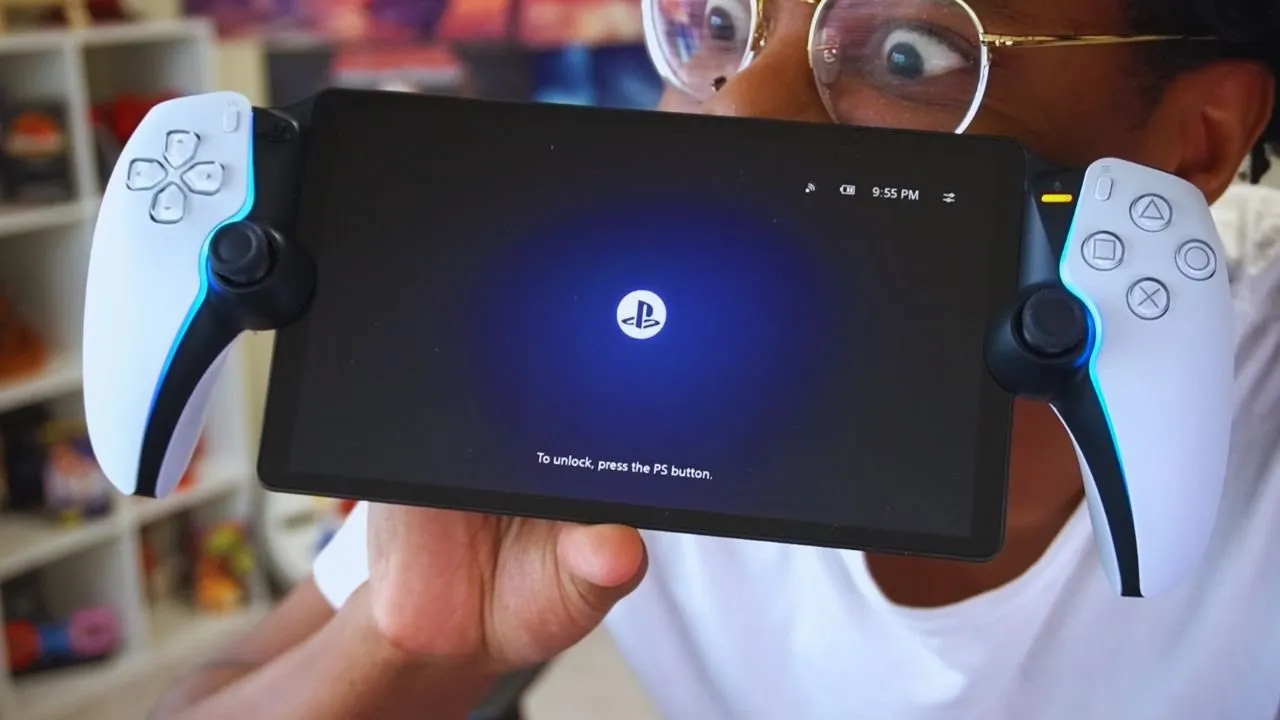
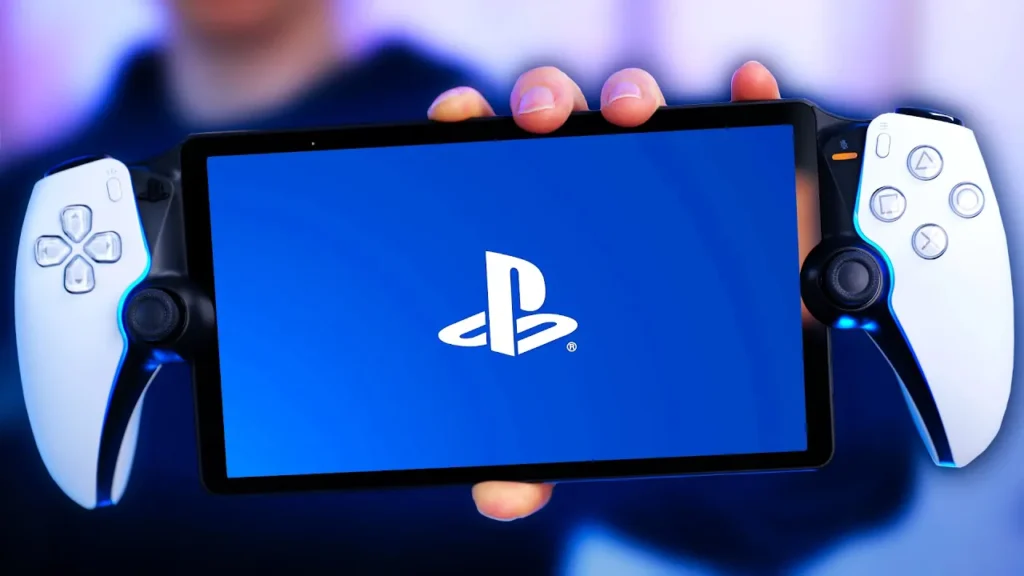
The first detail anyone notices about the PlayStation Portal is the controller. It is not a generic handheld controller layout. It is not a compromise. It is not a scaled-down imitation of the DualSense. It is the DualSense — complete with adaptive triggers, haptic feedback, and symmetrical stick placement. Sony understood that to replicate the true PS5 experience, it could not weaken the most defining element of the console generation: the controller.
The screen matters too. An 8-inch 1080p 60Hz display is large enough to showcase modern graphics clearly without feeling like a miniature phone screen. The 60Hz refresh rate is more than enough for streaming. Sony prioritized practicality rather than pushing a spec number without necessity.
When holding the device, players do not feel as if they are adjusting to a handheld. They feel as if their PS5 shrank into a personal format.
A Device Designed for Remote Play, Not Cloud Competition
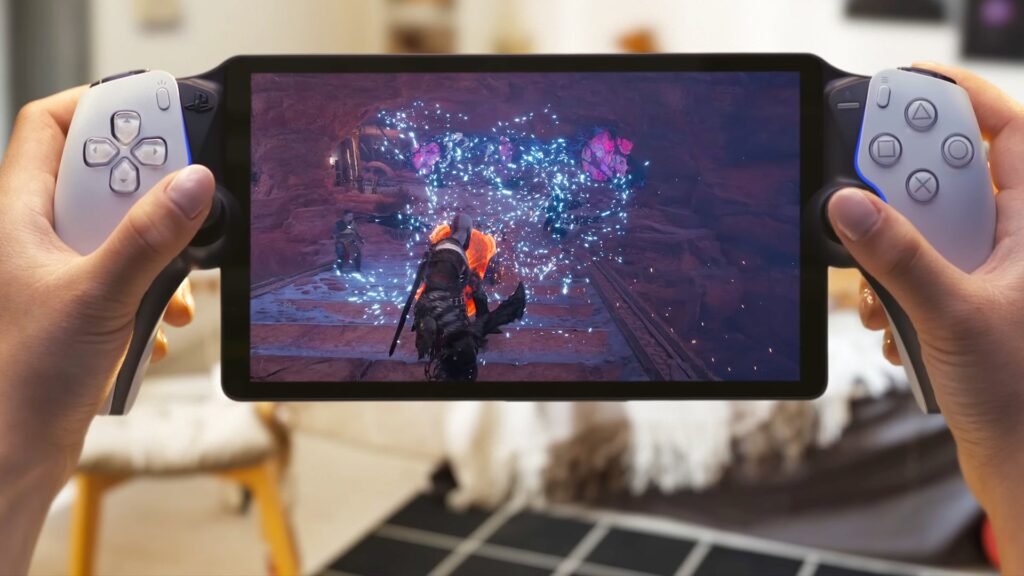
The PlayStation Portal sparks comparisons to the Nintendo Switch and the Steam Deck. But such comparisons are misleading, because those devices are built to run local games, while the PlayStation Portal is built to run your PS5 remotely. The Portal is not trying to be a handheld console; it is a Remote Play machine.
Two design decisions prove this:
- It requires a PlayStation 5 to function.
- It streams games instead of processing them internally.
This narrow focus does not make the device weaker. It makes it precise. Rather than dividing its hardware budget across internal processing, cooling, and graphics, Sony invested that budget into the controller, display, and connectivity hardware.
The Portal accomplishes what it was built for: zero-compromise PS5 gameplay on the go, assuming stable bandwidth.
The Dependence on Wi-Fi: Limitation or Long-Term Strategy?
The most controversial aspect of the PlayStation Portal is its dependence on internet connectivity. It does not operate as a standalone portable console. You cannot download games to it. When Wi-Fi is unstable, the experience suffers.
Critics see this as a weakness. Sony sees it as a long-term bet.
Sony is positioning the PlayStation Portal for a world where Wi-Fi and broadband continue to improve. The company is betting on the future of infrastructure, not the present. Cloud gaming companies are doing the same thing, though with a different technical model.
Just like electric cars were criticized before charging infrastructure matured, the PlayStation Portal is criticized before global home broadband reaches universal stability. Sony is not reacting to the present. Sony is preparing for the future.
In that future — the future Sony anticipates — latency, bandwidth, and streaming technology make physical distance irrelevant.
The Real Value Proposition
PlayStation Portal gives PS5 users something many did not realize they were missing: freedom from the living room. It allows a game to continue without interruption, whether someone else wants the TV or the player wants a change of environment.
Bedroom.
Balcony.
Kitchen counter.
Garage.
Hotel room.
Grandparent’s house.
A private quiet space at midnight when everyone else is asleep.
The PlayStation Portal does not expand the PlayStation ecosystem through complexity. It expands it through accessibility.
Why Sony Did Not Add Bluetooth
The absence of native Bluetooth audio was another talking point among reviewers. Sony would argue that this is not a flaw, but a design decision. Bluetooth introduces latency. If Sony allows Bluetooth headphones during high-speed gameplay, the audio delay would degrade the experience. Instead, Sony is constructing a proprietary PlayStation Link ecosystem designed for ultra-low-latency wireless audio.
This is controversial because it nudges customers toward Sony accessories. However, it is technically honest: Sony chose latency-free quality over universal compatibility.
Not a Cloud Device, Not a Standalone Console
Misunderstanding the PlayStation Portal often comes from expectations rather than performance. If someone wants a standalone handheld like the Nintendo Switch or a PC-powered handheld like the Steam Deck, then the PlayStation Portal is not the right match. But that does not make it incomplete.
The PlayStation Portal is the only handheld device designed specifically for:
• Zero-compromise DualSense experience
• Full PS5 library replication without scaling down graphics
• Seamless Remote Play without third-party complications
It is a niche product that succeeds precisely because it embraces its niche.
How the Portal Changes the Future of PlayStation
Sony rarely releases hardware without long-term strategic intent. The PlayStation Portal signals that PlayStation’s next decade will expand beyond the living room through remote access and streaming technologies. The PlayStation Portal is not the end goal — it is the first building block.
The future roadmap can logically evolve like this:
• PS5 plays anywhere
• Cloud processing reduces dependence on local hardware
• Subscription-driven libraries replace disc-only ecosystems
• Handheld and cloud gaming converge
The Portal introduces the PlayStation community to the idea that your console experience is not tied to your console’s location.
The Cultural Reaction
The reaction to the PlayStation Portal showed two contrasting groups of gamers:
Group 1: Gamers who want a portable PS5 experience without compromises to controller quality quickly appreciate the device.
Group 2: Gamers expecting a standalone gaming handheld are disappointed.
Sony knew this split would happen, but prioritized clarity over chasing every market segment. Rather than attempt an all-in-one system, Sony built a purpose-driven system — even if it risks misunderstandings.
The Emotional Connection of Play Anywhere
Gaming is not only technical. Gaming is emotional. It is an escape, a coping mechanism, a creative outlet, and a stage of achievement. The PlayStation Portal protects that relationship by making the PS5 accessible anywhere, without disrupting others.
Gaming becomes portable without simulation.
Gaming becomes flexible without losing depth.
Gaming becomes private without retreating to a shared TV space.
The PlayStation Portal blends lifestyle and entertainment.
The Future of Companion Hardware
The PlayStation Portal is part of a broader industry trend: companion devices growing alongside primary consoles. Sony is not abandoning traditional consoles. It is expanding them horizontally rather than vertically.
Instead of replacing the PS5 with a handheld, Sony has expanded the PS5 with a handheld.
This creates a parallel hardware line where:
• The PlayStation 5 remains the core
• The PlayStation Portal becomes the satellite device for convenience
• Accessories strengthen the ecosystem
This layered approach builds customer loyalty by making the PS5 more useful rather than replacing it.
Not Built for Everyone — and That Is Strength
A product weakens when it tries to please every audience. A product becomes iconic when it understands exactly who it is built for.
The Portal is for players who:
• Prefer PS5 hardware but want mobility
• Value DualSense technology
• Want uninterrupted access to their games
• Do not want to adapt to touchscreens or third-party mounts
It excels for its intended audience.
Final Thoughts
The PlayStation Portal is not a competitor to the Switch, Steam Deck, or mobile cloud gaming. It is something fundamentally different. It is a device intentionally built around the idea that remote access to your PlayStation 5 — with full DualSense support — should be simple, fluid, and immersive.
It redefines what “portable gaming” means for the PlayStation ecosystem. It is not portable hardware running scaled-down titles. It is your PS5, everywhere.
While the Portal requires strong internet, while it cannot play standalone titles, and while it invites debate over accessory compatibility, these factors do not diminish its core purpose. They define it.
The PlayStation Portal is a message about the future of gaming: consoles are not just machines anchored to televisions. They are ecosystems that can travel with the player, without compromise.
Many gaming devices try to do everything. The Portal tries to do one thing — and does it with clarity, conviction, confidence, and identity.
The game no longer waits for the television. The game follows the player.